

By Lila MacLellan
Senior Writer | Lila MacLellan is a senior writer at Fortune, where she covers topics in leadership.
October 1, 2025
Intel’s employees needed some good news. The company may still boast one of Silicon Valley’s most storied names, but its staff, which numbered 96,000 as of the end of July, had worked for years through nearly uninterrupted decline, watching their company lose nearly all relevance. Though its stock price soared just before the pandemic on a data center boom, then again on an ambitious (and since abandoned) plan to expand its manufacturing business, Intel last produced truly leading-edge chips in 2017. While neighbors feasted on the AI boom, Intel couldn’t seem to find its footing.
So when employees logged on to watch a press conference on Sept. 18, anticipation was high. And finally, there was some good news to share: Intel CEO Lip-Bu Tan and Nvidia chief executive Jensen Huang appeared on a split screen to share the details of a surprise deal: Nvidia would be investing $5 billion into Intel, a hugely needed boost of capital and confidence from the most powerful man in business.
One senior manager, who did not want to be named as he is not authorized to speak publicly about internal matters, said his chat threads lit up. “Jensen likes us!” was the overwhelming reaction, he recalls. Many employees seemed to believe that Nvidia’s cash infusion and interest in partnering with Intel on chips, which followed investments from the federal government and SoftBank would help save the chipmaker.
Volumes have been written about the strategic mistakes that saw Intel go from dominating the microprocessor market in the ’90s to becoming a company in need of bailing out today. Most notably, Intel missed the mobile phone revolution in the early 2000s, when then-CEO Paul Otellini turned down Apple’s request to have Intel build chips for the first iPhone. The company also missed the AI boom, having stopped making the chips that hyperscalers and AI giants like Nvidia badly need seven years ago, and ceding that market to Taiwan’s TSMC and Korea’s Samsung. (Now, America’s reliance on those two makers is seen as a serious national security threat.)
But while Intel’s strategic missteps have been pored over, less analysis has been done on the changes in corporate culture that accompanied and arguably hastened Intel’s decline. Though it can be difficult to pull apart where poor business decisions end and cultural erosion begins, the people who might know best—Intel’s past and current employees—have theories.
One thing is for sure. The company that was once known for attracting the best and brightest, largely lost that ability. “You certainly have the true believers who are hanging on, but the change in direction, the layoffs, the comp not being as good as it should be—it’s all piling up,” said one former senior manager about what he knew of the mood at Intel in August. Morale, said another former longtime employee in project management, is “in the toilet.” Intel’s famed culture, over the past few years, had deteriorated into a “heads-down, push-through situation,” he added. “That spark in people’s eyes, the desire to do this work, was not there.”
How Intel originally found that spark—then lost it—is a worthy lesson for any high-flying company about how to keep a company culture alive.
The Grovian Era
Over the past 10 years, Intel has shed tens of thousands of jobs in several waves of restructuring, but the most drastic of those cuts happened in 2024 and 2025. First, in 2024, CEO Pat Gelsinger announced a reduction of 15,000 roles, after the company’s total headcount had grown to nearly 125,000. Now, Tan, who took the CEO office in March, has said another 25,000 roles would go and that he wants Intel to emulate Nvidia’s lean, fast-moving culture.
But there was a time when speed and size were not incompatible for the tech giant.
Intel was cofounded in 1968 by two legends of the silicon industry, Gordon Moore and Robert Noyce, and an investor named Arthur Rock.
Moore, who died in 2023, famously gave the world Moore’s law: the idea that the number of transistors that could be put on a chip doubles about every two years, enabling regular waves of advanced technological developments. But the leader whose imprint set the DNA for Intel’s corporate culture, and that of early Silicon Valley writ large, was Andy Grove, one of the company’s first employees, who became Intel’s third CEO in 1987 and oversaw stunning growth at the company. “He had this amazing stage presence,” said a former 30-year employee, an engineer who had also worked in operations management. “Just even being around him, he had so much energy and passion.”
Inspired by Moore’s law, Grove insisted that Intel needed to work ceaselessly to disrupt itself—“Only the paranoid survive” was one of his famous dictums—and Grove, who was born in Hungary to a Jewish family in 1936, was a survivor himself. He had concealed his Jewish identity during the German occupation of Budapest and lived under the Soviet regime before escaping to the West. The revered leader and engineering genius, who died in 2016, questioned corporate norms about top-down authority and encouraged a culture where employees were expected to challenge one another productively, a custom he called “constructive confrontation.”
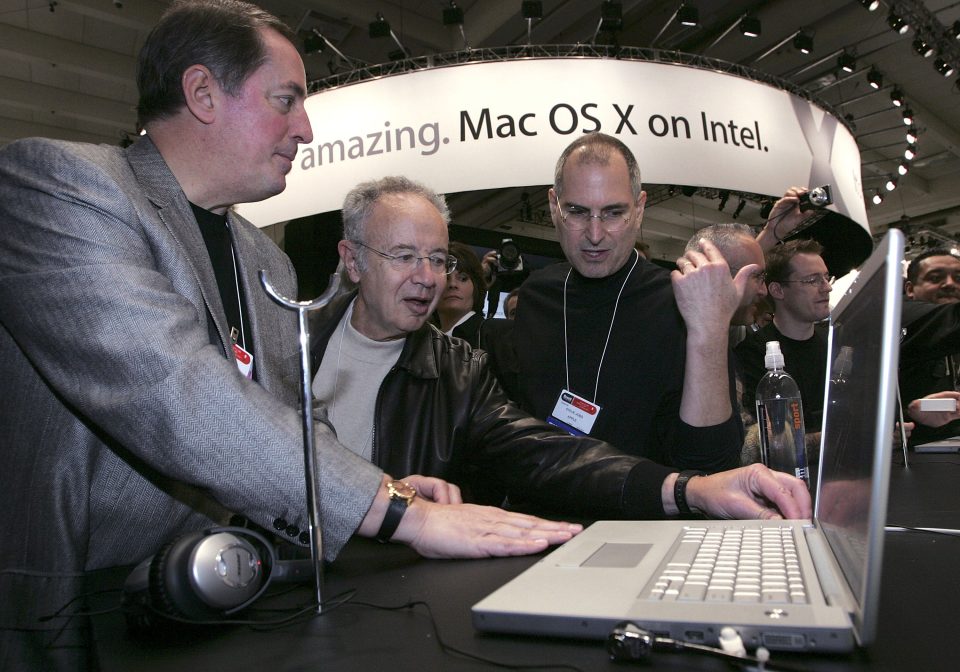 Late tech legends (from left): Former Intel CEOs Paul Otellini and Andy Grove, along with Apple’s Steve Jobs, admire the fruits of an Intel-Apple partnership in 2006.
Justin Sullivan—Getty Images
A believer in flat structures and the spirit of experimentation, Grove drove employees hard, but he also set the conditions for innovation, said the former longtime employee, and Grove was known for having an idealistic streak. “Back in the old days,” the former employee said, “it was like, ‘Oh, hey, I’m creating this great thing. What do you think about it?’ ” The typical response, he recalled, would be, “ ‘Hey, that looks pretty cool. Let’s see what you can do with it. Let’s give you some money and more tools.’ ”
And when workers had to grind to hit a production target, their efforts were rewarded, sometimes with financial incentives, but also with personalized awards like silicon wafers signed by Grove. In a former era, even years after Grove stepped down, one program provided free tickets to baseball games or museums for yourself and your family. The veteran employee remembers parties to celebrate accomplishments, and being able to take time off work between big projects “to give time back to your family,” after weeks or months of absence. Intel also ran a sabbatical program that was the envy of corporate drones everywhere: Every four years, workers could take four consecutive weeks of paid leave (in addition to vacation allowances) or they could take eight weeks after seven years.
With its emphasis on competitiveness and staying on the edge of technological advancement, plus the perks, Intel was the place where graduates of top computer science schools, such as Caltech, dreamed of landing a gig. It was a company where, several employees told me, people expected to spend their entire careers.
“Saying you worked at Intel was a feather in your cap,” said the former project manager, recalling Intel’s golden era in the 1990s and the turn of this century. “The bunny suit ads and ‘Intel Inside’ campaign were everywhere. It felt great to work there. People were motivated and proud.”
But, former employees said, the vibe began to change as far back as 15 years ago.
A cultural drift
Grove stepped down as CEO in 1998 (but remained involved as chair until 2005), and was followed by Craig Barrett, who, employees who spoke to Fortune said, largely kept Grove’s vision and emphasis on technological leadership intact. (Barrett is still focused on saving Intel.) But the CEO who followed Barrett, the late Otellini, who was the company’s first non-engineer CEO, began to make changes that many say the company never recovered from. He made that fateful decision not to work with Steve Jobs at Apple; he also started the company on a path that saw its financial performance take priority over Grove’s mission to be on the cutting edge of all forms of technology.
Intel had always championed its democratic ways, where employees were expected to reach out directly to senior leadership with ideas, and their input was valued, said ex-employees. That atmosphere slowly shifted over time, beginning in the 2000s. “Everyone was telling [Otellini], ‘This is something big we need to do,’ ” the former project manager said of mobile computing. “And he was just not having it.”
Experimentation lost its shine. Awards were minimized. The veteran employee points to Bob Swan, who was CEO from 2019 to 2021, as both an effective leader with great vision, but also a penny-pincher who changed Intel by wiping away even small perks: “By the time I left, if there was even a thank-you gift card, which was really hard to get approved, it would be anywhere from $25 to $100.”
Employees also gradually saw the downtime they had between projects evaporate, leading to burnout and decreased morale. More and more, said one former employee, Intel’s workers went from being valued and celebrated contributors to the company’s goals—part of a family, several said—to cogs in a machine designed to maximize profit. That felt most true during the last 12 months, said a former public relations manager.
“Your employees are the gas in the car, the talent you have, the people you trust to get things done. They should be considered. They should be part of the strategy,” that person said. “People felt that employees were starting to be treated like assets that you could sell off or just offload. It discounts your contribution.”
Former employees said that perceived attitude colored the company’s approach to layoffs, which were given titles, said one ex-worker, such as, “Corporate People Movement.” (Intel declined to confirm or comment.) “They always had fun names for them, but it was always just people were laid off,” the project management specialist said. It’s not uncommon for big companies to name programs that involve restructuring and layoffs, but that was exactly the point, employees said. Intel had never been like other big companies.
Not only that, but Intel mishandled its layoffs, at least at first, with damaging effects. One employee recalled layoffs more than 10 years ago, in which the company marched people out the door on the day they learned they had lost their job, leaving gaps in knowledge and sowing confusion. Eventually, the company had to revert to giving employees notice.
People learned about the regular layoffs and whether their teams would be impacted at the unfortunately named Business Unit Meetings, or BUMs, the project manager said. The atmosphere was filled with the dreaded question, Am I next? The ever-present fear of being laid off over the past few years “took your head out of the game,” said another.
A reason for hope
In 2021, the mood at Intel momentarily shifted for the better, several employees told Fortune. That year, the board hired Pat Gelsinger, an engineer who had spent 30 years at Intel before leaving it for other companies and eventually running VMware.
To many, Gelsinger’s return signaled that the company was reviving the spirit of Andy Grove’s Intel. Gelsinger spent billions, and literally bet the company on its advanced 18A production process architecture, employees explained. He laid the groundwork to build new foundries, but said Intel wouldn’t see the fruits of these investments for years. “We’re going to go all in, and we are going to make it. I really liked that mentality,” said the ex-longtime employee.
Gelsinger inspired employees—even as he asked them to take a pay cut, and he scaled back the sabbatical benefit—while also keeping them informed of his vision. As one former corporate leader recalled, the chief executive was known for addressing employees weekly and engaging with their questions. Where one former CEO was taken aback by employees’ confrontational culture, and even left the stage during a town hall out of frustration, Gelsinger was at home at Intel. But the board—which included Tan—reportedly lost patience with his spending, and he was dismissed last December, replaced by interim co-CEOs until Tan took control a few months later. “For most of us, when [Gelsinger] was forced out, it was really hard on morale, like, we just couldn’t believe it. We thought that this was the guy that could potentially save the company,” said the former 30-year employee.
By contrast, Tan was less familiar to employees, though well-connected to people like Nvidia’s Huang, AMD CEO Lisa Su, and others in the semiconductor world. Tan holds a master’s in nuclear engineering, but he has long worked as an investor and business leader, and is the former CEO of Cadence Design Systems. A board member for two years, Tan was familiar with Intel’s complexity and the ongoing debate over whether to split the company up, spinning off the foundries as a separate business.
But current and former employees describe Tan as missing in action, spotted in person only once at an ice cream social, presumably designed to soften the news about a strict return to office policy. (Many see the RTO rule as another tool for culling staff.) “I haven’t seen him, even by accident,” noted a current manager, who said Tan is “invisible.”
Tan deserves credit for being transparent about planned job losses from the beginning of his tenure, the manager said, but he has yet to articulate other intentions. For example, how will the recent investments factor into Intel’s longer-term strategy and viability? And who else is he talking to? Employees keep hearing rumors from the media about the next big customer, he said, but “nothing from management.”
In Tan’s very first meeting with employees, several people said, rank-and-file staffers were not shy about pushing for details around Gelsinger’s departure and expressing “salty” sentiments about Tan having quit the board in 2024, ostensibly for personal reasons, only to boomerang back, this time as CEO. Trust in the new leader is low for some. “Lip-Bu Tan did not focus on internal stakeholders, only investors and external stakeholders,” the former corporate employee said. Tan was also reportedly called out by some employees on an internal chat app for wearing a pullover branded with the logo of his former company, Cadence, during that first appearance.
In a statement, an Intel spokesperson said, “Lip-Bu is driving a cultural transformation that is critical to Intel’s future growth. We are taking steps to become a leaner, faster and more efficient company. Removing organizational complexity and empowering our engineers will enable us to better serve the needs of our customers, reignite innovation and strengthen our execution.”
In April, Tan also said on an earnings call, “Organizational complexity and bureaucracy have been suffocating the innovation and agility we need to win. It takes too long for decisions to get made. New ideas and the people who generate them have not been given the room or resources to incubate and grow. And unnecessary silos have led to bad execution. I’m here to fix this.”
One of the biggest surprise events since Tan took office happened in August, when the CEO agreed to have the U.S. government take a 10% stake in the company for $8.9 billion in funding that had already been promised to the company in federal grants. That development seemed inevitable and had long been discussed at Intel, one employee said. But it didn’t sit well with everyone. “It’s insane that the U.S. government would be owning a stake in an independent company,” said the employee in project management, just days after that deal went public. “It just seems gross, especially for people who don’t necessarily support Trump. They feel like they are now being pulled into his orbit closer than they want to be.”
“Frankly, some of the employees just don’t want to be involved with Trump in any way, shape, or form, just because it’s him,” said another former leader, who also described Intel as a little more conservative than some other tech companies, especially because it’s spread out across various geographies and includes a manufacturing business. “Our past founders have warned current leaders in the company very publicly that taking government money comes with a lot of strings attached.”
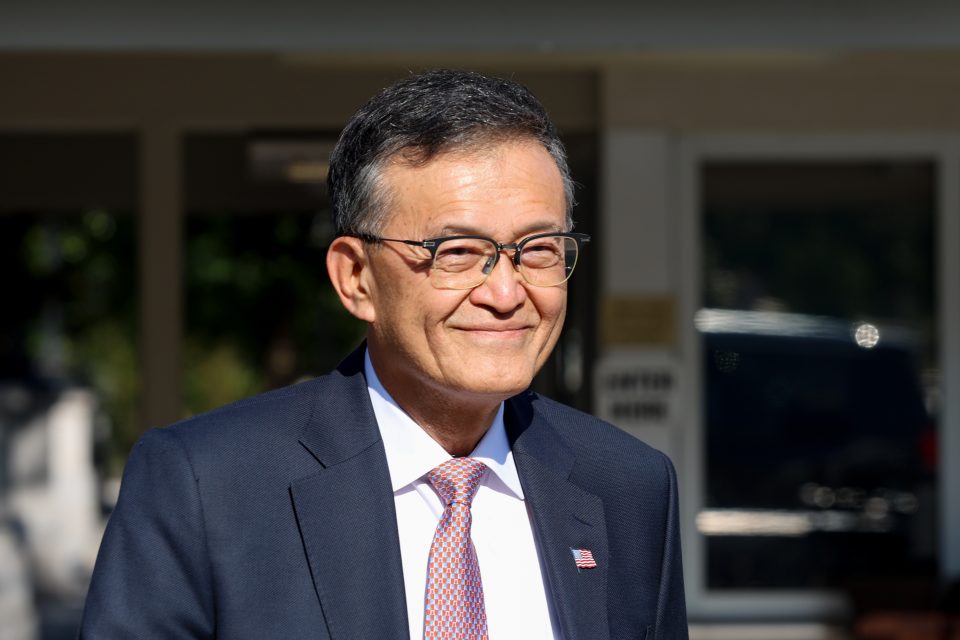 CEO Lip-Bu Tan is externally focused, current and former employees say.
Alex Wroblewski—Bloomberg/Getty Images
Amid layoffs, Tan has framed a few new hires as a positive development for the company, said a former PR manager, but the message was cold comfort to those who lost their jobs. “Pretty much, the only good news he had would be to come in and say, ‘I’m bringing in some new people. They’re going to really innovate, and I trust them. I know them, and they’re going to be great for this company.’ The message the employees got was: He’s bringing in people who are going to get paid way more than you are, and you’re losing your job.”
In June, Intel also told workers that many of their jobs, especially in marketing, would be outsourced to Accenture, the IT consulting firm, which will use AI technology to replace many functions.
One month later, when Tan said that Intel would only continue investing in Intel 14A, its next-gen technology, based on customer interest, “it was such a shock to the system,” a former senior manager said. Research and development had been driven by an “If you build it, they will come” mentality. “[Tan] might be right,” the ex-manager said, acknowledging the economic pressures facing the CEO, “but it’s a big change in company philosophy.”
Now, with unconfirmed reports circulating that Intel is seeking investments from Apple and rival TSMC, his focus on external players seems understandable. Ex-employees point out that Tan has indeed been executing on the plans he described when he took over. One former corporate employee thinks that Intel still needs to develop the mindset to both compete and work collaboratively with peer companies in today’s tech ecosystem. For years, Intel has been mostly insular, and the prevailing attitude was that to be the best company, it needed to rely on itself. But that was a form of hubris. “It was part of what brought Intel into that dominance for several years,” said the ex-employee. “At the same time, it brought all the challenges that we have been seeing over the last few years.” Now that Intel has lost its status as the top destination for the brightest minds in engineering, some former workers think recruiting for Intel’s next act will be difficult. “Most people want to be part of a growth story, not a turnaround story,” said the former senior manager, “unless the turnaround has legs.” But should the company need to staff up again, it would also likely find much goodwill among its laid-off employees.
Because of the years in which Intel cultivated a strong and distinctive culture, ex-employees said, former Intel employees are networking regularly, sharing job openings, and even getting ready to launch their own businesses, while rooting for their old employer. Asked if he would go back, the veteran employee, who said he is still adjusting to his new post-Intel identity, replied, “In a heartbeat.”
Source: https://shorturl.at/nOUbO