


By Holly Chik
Researchers say cooling innovation can lower temperature of overheated ‘hotspots’ on solar cells that can cause panel failure and fire risk
Chinese scientists have developed a hydrogel cooling coating for solar panels to boost power output by 13 per cent compared to conventional photovoltaic systems.
The transparent layer can reduce the temperature of “hotspots” – overheated areas on solar cells caused by defects, shading from leaves, bird droppings or dirt – by 16 degrees Celsius (nearly 30 Fahrenheit). Hotspots are a common cause of solar panel failure and fire risk.
“On a global scale, our developed cooling strategy can offset around 50 per cent of power generation loss caused by hotspots in [building-integrated photovoltaics], highlighting its significant potential for future applications,” the researchers from Hong Kong Polytechnic University, Tianjin University and Hebei University of Technology wrote in a paper in the peer-reviewed journal Advanced Energy Materials in September.
Since publishing their findings, the team reported receiving positive feedback and interest from several companies keen to collaborate on commercialising the cooling hydrogel technology.
Lead author Jerry Yan Jinyue, PolyU’s chair professor of energy and buildings, said the team’s “next steps are to launch large-scale deployments and work with industry partners to bring this technology to mainland China and other countries around the world”.
“This coating is especially useful in hot, sunny regions near the equator, such as Southeast Asia and southern China, where solar panels are more likely to overheat.”
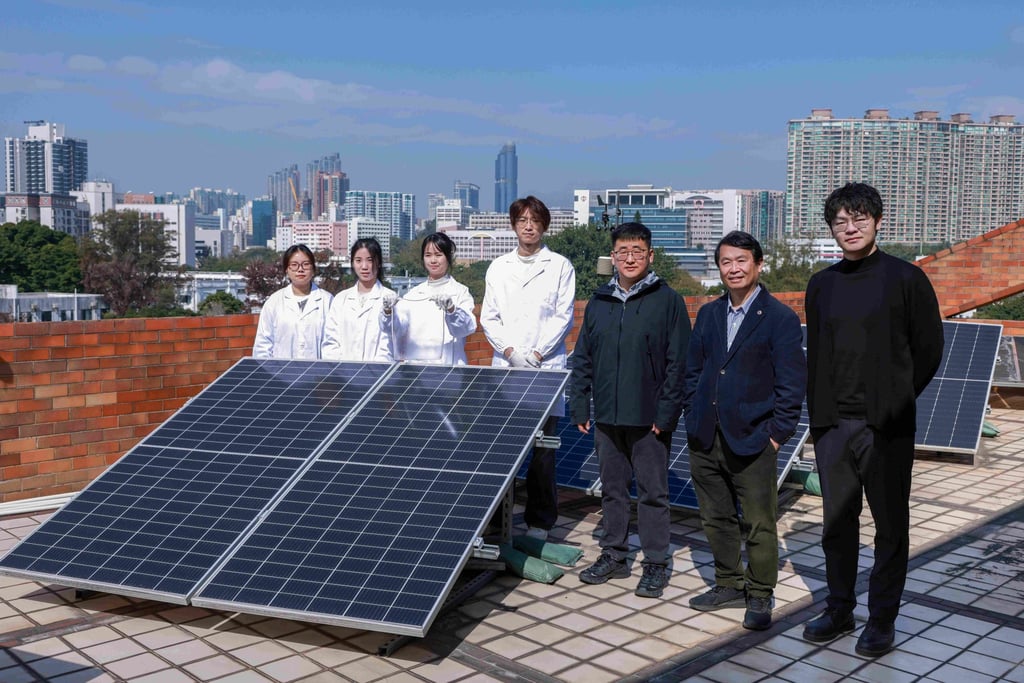
Study lead author Jerry Yan (second right) says the research team plans to install the technology on a larger scale at the PolyU campus to further test its effectiveness in real-world conditions. Photo: Handout
In the study, the hydrogel lowered the temperature of photovoltaic panels shaded by a tree from 55.7 degrees to 39.4 degrees, a drop of 16.3 degrees.
Adding the hydrogel system increased the cost of a solar panel by around 10.7 per cent, Yan said.
“However, in places with high electricity prices and lots of sunlight, like Singapore and Hong Kong, the extra cost can be paid back in just three to 4½ years, thanks to the extra electricity generated.
“In places with lower electricity prices, like Tianjin, the payback period is longer, but we expect costs to decrease as we scale up production,” he said. The study estimated the payback period for the mainland Chinese city to be 11.1 years.
Yan said “hotspots” could cause energy loss and sometimes damage solar panels.
“For every degree the panel gets hotter, it loses about 0.4 to 0.5 per cent of its efficiency. Hotspots also speed up ageing and, in rare cases, can cause fires. Studies show that over a third of solar panels have experienced these overheating problems, with an average temperature increase of 21.7 degrees in affected areas,” he said.
To address this issue, the team developed a hydrogel coating made from a water-absorbing material called polyacrylamide, which was strengthened by adding a thickening agent called hydroxyethyl cellulose.
“We also weave in cotton threads in a leafy pattern to help move water to the hottest areas, keeping the cooling effect even and long-lasting. On top, there is a thin, porous layer of polytetrafluoroethylene that keeps dust off and controls how quickly water evaporates,” he said.
Polytetrafluoroethylene is commonly known by its trade name Teflon and is used as a non-stick coating on cookware.
Outdoor tests conducted over several months showed that the hydrogel coating was stable and reliable, Yan said, adding that the team planned to install it on a larger scale at the PolyU campus this year to further test its effectiveness in real-world conditions.
Source: chinese-teams-hydrogel-coating-boosts-solar-panel-power-output-13-ideal-hot-regions
Disclaimer
The views and opinions expressed in this article are solely those of the author and do not necessarily reflect the official stance of Kritik.com.my. As an open platform, we welcome diverse perspectives, but the accuracy and integrity of contributed content remain the responsibility of the individual writer. Readers are encouraged to critically evaluate the information presented.