

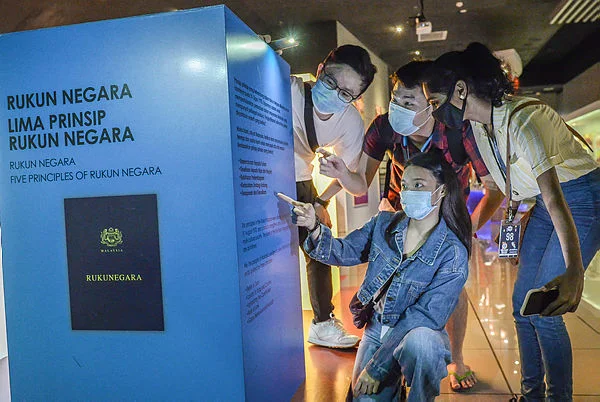
THE significance of the Rukun Negara as a guiding framework for national ethics has never been more relevant than it is today, particularly in an era defined by rapid technological change and shifting social values.
Introduced as the nation’s guiding philosophy, the Rukun Negara was designed to strengthen unity, foster stability and anchor shared values within Malaysia’s diverse society. Its formulation followed the events of May 13, 1969, a defining and sensitive chapter in the country’s history that underscored the urgent need for a common national foundation.
Its five principles, long embedded in schools and civic life, were intended to nurture a shared moral foundation and national consciousness from an early age. Over time, they have helped shape Malaysia’s identity and sustain coexistence across ethnic and religious lines.
Yet Malaysia today is not the Malaysia of decades past. Daily headlines point to violence, fraud, abuse and growing hostility in both digital and physical spaces.
While these trends are often linked to economic pressures and rapid technological change, they also point to a deeper concern: the gradual erosion of a shared moral foundation.
In this context, the Rukun Negara is more necessary than ever. Of its five principles, two stand out in addressing current ethical and behavioural challenges.
The first is “Belief in God” (Kepercayaan kepada Tuhan). Beyond religious identity, it speaks about personal moral responsibility. A strong ethical foundation helps society resist corruption, violence and exploitation. When belief is reduced to symbolism rather than practice, that sense of restraint weakens. Many instances of fraud and abuse reflect not only institutional gaps but also a lack of internalised accountability.
The second is “Good Behaviour and Morality” (Kesopanan dan Kesusilaan). This is most evident in everyday conduct – how individuals engage with one another in both public and private spaces.
Rising concerns over cyberbullying, domestic strain and increasingly confrontational behaviour suggest a weakening of respect and empathy. Courtesy, once taken for granted, now requires deliberate practice; without it, trust erodes and social cohesion begins to fray.
While all five principles remain important, including the “Rule of Law” and “Loyalty to King and Country”, the former two are particularly critical in shaping the behaviours that underpin a stable society.
If these values are weakening, the response must begin early, particularly among young Malaysians.
Education should not be confined to academic achievement; it must also build character, ethical awareness and a sense of purpose.
One way forward lies in experiential, purpose-driven learning. When education is connected to real-world engagement, it helps young people develop direction alongside responsibility.
Through workshops and projects, students can be guided to articulate their purpose, define their aspirations and translate them into clear and meaningful contributions to society.
By supporting B40 communities, orphanages as well as animal welfare and environmental causes, these experiences can help cultivate leadership, empathy and a strong sense of civic responsibility among young adults.
Ultimately, the principles of the Rukun Negara can be meaningfully internalised and reflected in everyday life. However, this requires sustained commitment, particularly through education that integrates knowledge with character and civic responsibility.
Only then can the values of the Rukun Negara be fully lived, shaping a more cohesive and resilient Malaysia.
Dr Lee J. Peter is an assistant professor at Heriot-Watt University Malaysia. Comments: letters@thesundaily.com
Source: rukun-negara-reclaiming-malaysias-moral-compass
Disclaimer
The views and opinions expressed in this article are solely those of the author and do not necessarily reflect the official stance of Kritik.com.my. As an open platform, we welcome diverse perspectives, but the accuracy and integrity of contributed content remain the responsibility of the individual writer. Readers are encouraged to critically evaluate the information presented.