


By Rashmila Maiti
Fast fashion is the second-biggest consumer of water and responsible for about 10% of global carbon emissions – more than all international flights and maritime shipping combined. Unfortunately, the industry’s problems are often overlooked by consumers.
Fast fashion, a term now central to discussions on sustainability and environmental consciousness, refers to a business model characterized by the rapid design, production, and marketing of inexpensive clothing.
Fast fashion companies focus on low-cost garments that replicate the latest fashion trends, quickly pushing them into stores to capitalize on these trends. This means that retailers are able to offer a greater variety of products in large quantities and allow consumers to get more fashion and product differentiation at a low price.
The term was first used at the beginning of the 1990s, when Zara landed in New York. The term “fast fashion” was coined by the New York Times to describe Zara’s mission to allow garments to go from the design stage to being sold in stores in just 15 days. The biggest players in the fast fashion world include Spanish fashion giant Zara, Chinese Shein, Japanese UNIQLO, and Swedish H&M.
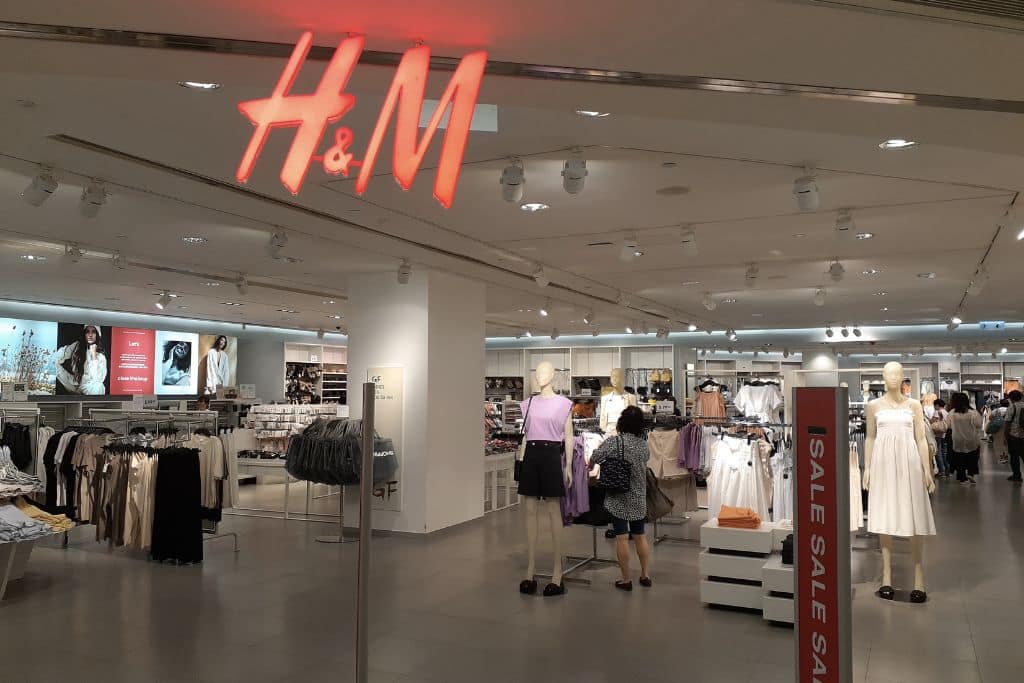
Fast fashion retailers put out new styles to customers at a record pace, consuming huge amounts of resources and generating mountains of waste. Photo: Wikimedia Commons.
The Dark Side of Fast Fashion
According to an analysis by Business Insider, fashion production comprises 10% of total global carbon emissions, as much as the emissions generated by the European Union. The industry dries up water resources and pollutes rivers and streams, while 85% of all textiles go to dumps each year. Even washing clothes releases 500,000 tons of microfibers into the ocean each year, the equivalent of 50 billion plastic bottles.
The Quantis International 2018 report found that the three main drivers of the industry’s global pollution impacts are dyeing and finishing (36%), yarn preparation (28%) and fiber production (15%). The report also established that fiber production has the largest impact on freshwater withdrawal (water diverted or withdrawn from a surface water or groundwater source) and ecosystem quality due to cotton cultivation, while the dyeing and finishing, yarn preparation and fiber production stages have the highest impacts on resource depletion, due to the energy-intensive processes based on fossil fuel energy.
According to the UN Framework Convention on Climate Change, emissions from textile manufacturing alone are projected to skyrocket by 60% by 2030.
The time it takes for a product to go through the supply chain, from design to purchase, is called lead time. In 2012, Zara was able to design, produce and deliver a new garment in two weeks; Forever 21 in six weeks and H&M in eight weeks. Newer industry player Shein, a major Chinese fast fashion company, has garments ready to be sold in just 10 days. This results in the fashion industry producing obscene amounts of waste.
Fast Fashion and Its Environmental Impact
1. Water
The environmental impact of fast fashion comprises the depletion of non-renewable resources, emission of greenhouse gases and the use of massive amounts of water and energy. The fashion industry is the second-largest consumer of water among industries, requiring about 700 gallons to produce one cotton shirt and 2,000 gallons of water to produce a pair of jeans.
Business Insider also cautions that textile dyeing is the world’s second-largest polluter of water, since the water leftover from the dyeing process is often dumped into ditches, streams or rivers.
2. Microplastics
Furthermore, brands use synthetic fibers like polyester, nylon and acrylic which take hundreds of years to biodegrade. A 2017 report from the International Union for Conservation of Nature (IUCN) estimated that 35% of all microplastics – tiny pieces of non-biodegradable plastic – found in the ocean come from the laundering of synthetic textiles like polyester.
According to 2015 documentary The True Cost, the world consumes around 80 billion new pieces of clothing every year – 400% more than the consumption twenty years ago. The average American now generates 82 pounds of textile waste each year. The production of leather requires large amounts of feed, land, water and fossil fuels to raise livestock, while the tanning process is among the most toxic in all of the fashion supply chain because the chemicals used to tan leather – including mineral salts, formaldehyde, coal-tar derivatives and various oils and dyes – are not biodegradable and contaminate water sources.
3. Energy
The process of making plastic fibers into textiles is an energy-intensive process that requires large amounts of petroleum and releases volatile particulate matter and acids like hydrogen chloride. Additionally, cotton, which is in a large amount of fast fashion products, is also not environmentally friendly to manufacture. Pesticides deemed necessary for the growth of cotton present health risks to farmers.
To counter this waste caused by fast fashion, more sustainable fabrics that can be used in clothing include wild silk, organic cotton, linen, hemp, and lyocell.
The Social Impacts of Fast Fashion
Fast fashion does not only have a huge environmental impact. In fact, the industry also poses societal problems, especially in developing economies. According to non-profit Remake, 80% of apparel is made by young women between the ages of 18 and 24. A 2018 US Department of Labor report found evidence of forced and child labour in the fashion industry in Argentina, Bangladesh, Brazil, China, India, Indonesia, Philippines, Turkey, Vietnam and others. In fast fashion, sales and profits often take precedence over human welfare.

Garment factory in the Philippines. Photo: ILO Asia-Pacific/Flickr.
In 2013, an eight-floor factory building that housed several garment factories collapsed in Dhaka, Bangladesh, killing 1,134 workers and injuring more than 2,500. In her project An Analysis of the Fast Fashion Industry, Annie Radner Linden suggests that “the garment industry has always been a low-capital and labour intensive industry.”
In her book No Logo, Naomi Klein argues that developing nations are viable for garment industries due to “cheap labour, vast tax breaks, and lenient laws and regulations.” According to The True Cost, one in six people work in some part of the global fashion industry, making it the most labour-dependent industry. Developing nations often lack strict environmental regulations. For example, China is a major producer of fast fashion but suffers from significant land degradation and air and water pollution.
Is Slow Fashion the Solution?
Slow fashion is the widespread reaction to fast fashion and its environmental impact, the argument for hitting the brakes on excessive production, overcomplicated supply chains, and mindless consumption. It advocates for manufacturing that respects people, the environment and animals.
The World Resources Institute suggests that companies need to design, test and invest in business models that reuse clothes and maximize their useful life. The UN has launched the Alliance for Sustainable Fashion to address the damages caused by fast fashion. It is seeking to ‘halt the environmentally and socially destructive practices of fashion’.
One way that shoppers are reducing their consumption of fast fashion is by buying from secondhand sellers like ThredUp Inc. and Poshmark, both based in California, USA; shoppers send their unwanted clothes to these websites and people buy those clothes at a lower price than the original. Another solution is renting clothes, like the US-based Rent the Runway and Gwynnie Bee, the UK based Girl Meets Dress, and the Dutch firm Mud Jeans that leases organic jeans which can be kept, swapped or returned.
Other retailers like Adidas are experimenting with personalized gear to cut down on returns, increase customer satisfaction and reduce inventory. Ralph Lauren has announced that it will use 100% sustainably-sourced key materials by 2025.
Governments must take a more active role in addressing the harmful effects of the fashion industry. In 2019, UK ministers rejected a report by members of parliament to address the environmental effects of fast fashion. On the other hand, French President Emmanuel Macron has made a pact with 150 brands to make the fashion industry more sustainable.
The best advice on reducing the environmental impact of fast fashion comes from Patsy Perry, Senior Lecturer in fashion marketing at the University of Manchester, who says, “Less is always more.”
Featured image by EO Photographer Chin Leong Teo.
This article was updated on January 29, 2026. It was originally published in December 2022.
Source: fast-fashions-detrimental-effect-on-the-environment
Disclaimer
The views and opinions expressed in this article are solely those of the author and do not necessarily reflect the official stance of Kritik.com.my. As an open platform, we welcome diverse perspectives, but the accuracy and integrity of contributed content remain the responsibility of the individual writer. Readers are encouraged to critically evaluate the information presented.